
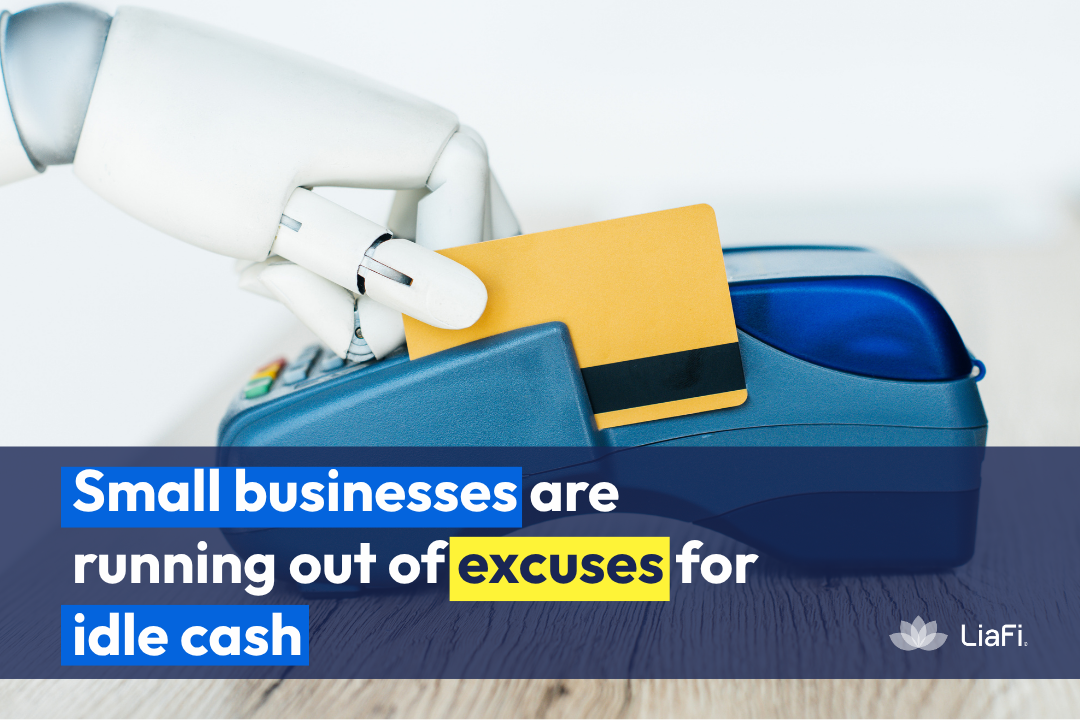
AI cash management for small business is becoming more relevant because most owners are already dealing with the same problem: they have money sitting in their business account, but they are not always sure how much of it is truly needed right now.
That uncertainty is normal.
Small business owners are not treasury teams. They are managing customers, employees, payroll, vendors, invoices, taxes, growth plans, unexpected expenses… Even when they know some of their cash may be sitting idle, finding the time and confidence to act on it can be difficult.
So, money stays where it is because it feels safe. It is available. It is familiar. It does not require another decision. And for many business owners, that simplicity matters.
But business finance is changing. AI is starting to move from answering questions to helping with real workflows. In financial services, Anthropic recently released ready-to-run agent templates for tasks like KYC screening, general ledger reconciliation, month-end close, statement auditing, and financial modeling. The company also noted that users remain involved by reviewing and approving Claude’s work before it is acted on.
That shift matters for small businesses too.
AI does not need to replace the owner’s judgment. Its real value is helping surface information faster, reduce manual work, and make financial decisions easier to understand.
Why small businesses leave cash idle
Most small businesses leave cash idle for practical reasons.
The owner may know that earning more on unused funds would be helpful. They may even understand that idle cash has an opportunity cost. But knowing something and acting on it are two very different things.
The first issue is time.
Cash management sounds simple until someone actually has to do it. The owner needs to check balances, understand what expenses are coming up, estimate how much cash should stay available, think about upcoming payroll, review tax obligations, and decide whether any excess cash can safely be moved.
That is a lot of thinking for something that does not feel urgent today.
The second issue is uncertainty.
A business account balance can look healthy in the morning and feel much tighter once payroll, rent, insurance, software bills, and vendor payments are taken into account. Many owners would rather keep too much cash available than risk being caught short.
That instinct makes sense.
Cash is emotional for small businesses. It represents safety, flexibility, and control. When an owner leaves money in one place, they are often trying to protect the business from surprises.
The problem is that too much protection can quietly turn into missed potential.
Idle cash is easy to ignore because it does not feel broken
Some business problems are impossible to ignore. If a customer is late with payment, payroll is coming up, a vendor invoice needs to be handled, or revenue suddenly dips, the owner has to react quickly. Those problems create pressure because they are visible and immediate.
Idle cash works differently. It can sit in the account for months without creating any obvious alarm. The business still runs, bills still get paid, and nothing looks broken from the outside. That is exactly why the issue often stays unnoticed until an accountant, advisor, or finance partner points out that part of the balance may not be needed for immediate expenses.
This is where cash flow visibility becomes important. When a business can clearly see what cash is needed, what cash is available, and what cash may be excess, the decision becomes much easier to make with confidence.
How AI cash management changes the workflow
AI cash management changes the starting point for small business owners. Instead of expecting them to manually review balances, upcoming expenses, payroll, tax payments, vendor obligations, and possible excess cash, AI can help organize that picture first.
For example, a business owner might see $180,000 in their account and feel comfortable leaving it there because payroll, rent, and inventory payments are coming up. But without better visibility, it is hard to know whether the full amount needs to stay untouched or whether part of it is simply sitting idle.
A useful AI-assisted workflow could help review normal cash patterns, upcoming obligations, and available balances, then surface a simple question: does part of this cash appear unused right now, and should the owner consider putting it to work?
That is very different from saying AI should take over financial decisions. The value is in making the decision easier to review, not removing the owner from the process.
The owner still makes the decision
Small business owners understand their businesses in ways software never fully can. They know when a slower season is coming, which customers usually pay late, whether a large purchase may be needed soon, or when keeping extra cash available simply feels smarter.
That context matters.
AI can help with patterns, visibility, and workflow preparation, but the final decision should stay with the person responsible for the business. The strongest version of AI cash management is not one where the owner loses control. It is one where the owner gets clearer information and less manual work before making a decision.
This is especially important in finance, where trust matters. Business owners need to know that AI is not quietly moving money in the background. A safer and more practical model is simple: AI identifies the opportunity, prepares the next step, and the owner reviews and approves the action.
Why this matters for small business cash flow
Small business cash flow is rarely predictable enough to manage on autopilot. Revenue can come in waves, customers can pay late, expenses can cluster together, and growth often requires spending before the return shows up.
That is why cash optimization has to respect liquidity. The goal is not to move money just because it is available. The goal is to understand what cash is needed, what cash should stay flexible, and what cash may have room to work harder.
This is also why the old excuses are getting weaker.
In the past, a business owner could reasonably say they did not have time to review idle cash, did not know how much they could safely move, or did not want to deal with another financial process. Those reasons were valid because the work was manual and the risk of misjudging liquidity felt real.
AI does not remove every concern, but it can make the decision easier to see. If the opportunity is visible, the workflow is simpler, and the owner still approves every action, idle cash becomes harder to ignore.
Conclusion
For small businesses, idle cash has always been easy to leave alone because acting on it required time, confidence, and extra work. AI cash management changes that by helping owners see the opportunity more clearly before making a decision.
The future is not about handing control of business money to AI. It is about using AI to reduce the manual work around cash visibility, cash optimization, and idle cash management.
Small business owners can stay in control, but they no longer have to manage every cash decision from scratch. And once they can clearly see which funds may be sitting unused, doing nothing becomes a much more deliberate choice.